• español
    • English
  • Login
  • español 
    • español
    • English

UniversidaddeCádiz

Área de Biblioteca, Archivo y Publicaciones
Comunidades y colecciones
Ver ítem 
  •   RODIN Principal
  • Producción Científica
  • Artículos Científicos
  • Ver ítem
  •   RODIN Principal
  • Producción Científica
  • Artículos Científicos
  • Ver ítem
JavaScript is disabled for your browser. Some features of this site may not work without it.

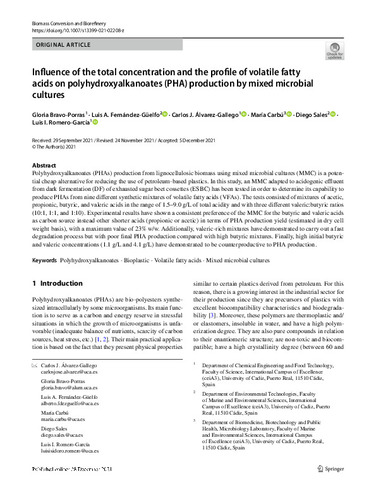
Influence of the total concentration and the profile of volatile fatty acids on polyhydroxyalkanoates (PHA) production by mixed microbial cultures
Thumbnail
Identificadores

URI: http://hdl.handle.net/10498/25935

DOI: 10.1007/s13399-021-02208-z

ISSN: 2190-6815

ISSN: 2190-6823 (internet)

Ficheros
APC_2021_075.pdf (2.127Mb)
Estadísticas
Ver estadísticas
Métricas y Citas
 
Compartir
Exportar a
Exportar a MendeleyRefworksEndNoteBibTexRIS
Metadatos
Mostrar el registro completo del ítem
Autor/es
Bravo Porras, Gloria; Fernández Güelfo, Luis AlbertoAutoridad UCA; Álvarez Gallego, Carlos JoséAutoridad UCA; Carbú Espinosa de los Monteros, MaríaAutoridad UCA; Sales Márquez, DiegoAutoridad UCA; Romero García, Luis IsidoroAutoridad UCA
Fecha
2021-12
Departamento/s
Biomedicina, Biotecnología y Salud Pública; Ingeniería Química y Tecnología de Alimentos; Tecnologías del Medio Ambiente
Fuente
Biomass Conv. Bioref. (2021)
Resumen
Polyhydroxyalkanoates (PHAs) production from lignocellulosic biomass using mixed microbial cultures (MMC) is a potential cheap alternative for reducing the use of petroleum-based plastics. In this study, an MMC adapted to acidogenic effluent from dark fermentation (DF) of exhausted sugar beet cossettes (ESBC) has been tested in order to determine its capability to produce PHAs from nine different synthetic mixtures of volatile fatty acids (VFAs). The tests consisted of mixtures of acetic, propionic, butyric, and valeric acids in the range of 1.5–9.0 g/L of total acidity and with three different valeric:butyric ratios (10:1, 1:1, and 1:10). Experimental results have shown a consistent preference of the MMC for the butyric and valeric acids as carbon source instead other shorter acids (propionic or acetic) in terms of PHA production yield (estimated in dry cell weight basis), with a maximum value of 23% w/w. Additionally, valeric-rich mixtures have demonstrated to carry out a fast degradation process but with poor final PHA production compared with high butyric mixtures. Finally, high initial butyric and valeric concentrations (1.1 g/L and 4.1 g/L) have demonstrated to be counterproductive to PHA production.
Materias
Polyhydroxyalkanoates; Bioplastic; Volatile fatty acids; Mixed microbial cultures
Colecciones
  • Artículos Científicos [12001]
  • Articulos Científicos Biomedicina [582]
  • Articulos Científicos Ing. Quim. [313]
  • Artículos Científicos IVAGRO [733]
  • Articulos Científicos Tec. Med. Amb. [215]
Atribución 4.0 Internacional
Esta obra está bajo una Licencia Creative Commons Atribución 4.0 Internacional

Listar

Todo RODINComunidades y ColeccionesPor fecha de publicaciónAutoresTítulosMateriasEsta colecciónPor fecha de publicaciónAutoresTítulosMaterias

Mi cuenta

AccederRegistro

Estadísticas

Ver Estadísticas de uso

Información adicional

Acerca de...Deposita en RODINPolíticasNormativasDerechos de autorEnlaces de interésEstadísticasNovedadesPreguntas frecuentes

RODIN está accesible a través de

OpenAIREOAIsterRecolectaHispanaEuropeanaBaseDARTOATDGoogle Académico

Enlaces de interés

Sherpa/RomeoDulcineaROAROpenDOARCreative CommonsORCID

RODIN está gestionado por el Área de Biblioteca, Archivo y Publicaciones de la Universidad de Cádiz

ContactoSugerenciasAtención al Usuario

