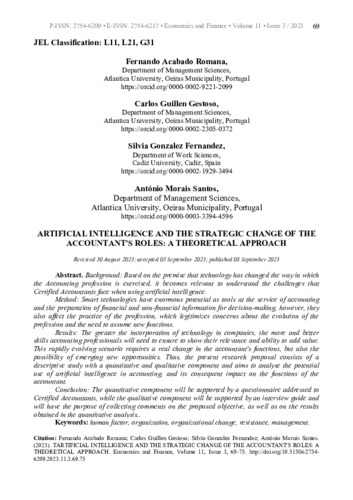
ARTIFICIAL INTELLIGENCE AND THE STRATEGIC CHANGE OF THE ACCOUNTANT'S ROLES: A THEORETICAL APPROACH
Identificadores
URI: http://hdl.handle.net/10498/31738
ISSN: 2754-6209
ISSN: 2754-6217
ISSN: http://doi.org/10.51586/2754-6209.2023.11.3.69.75
Statistics
Export





Metadata
Show full item record
Date
2023-09-08Source
Fernando Acabado Romana; Carlos Guillen Gestoso; Silvia Gonzalez Fernandez; António Morais Santos. (2023). TARTIFICIAL INTELLIGENCE AND THE STRATEGIC CHANGE OF THE ACCOUNTANT'S ROLES: A THEORETICAL APPROACH. Economics and Finance, Volume 11, Issue 3, 69-75. http://doi.org/10.51586/2754- 6209.2023.11.3.69.75Abstract
Based on the premise that technology has changed the way in which the Accounting profession is exercised, it becomes relevant to understand the challenges that Certified Accountants face when using artificial intelligence.The greater the incorporation of technology in companies, the more and better
skills accounting professionals will need to ensure to show their relevance and ability to add value.
This rapidly evolving scenario requires a real change in the accountant's functions, but also the
possibility of emerging new opportunities. Thus, the present research proposal consists of a
descriptive study with a quantitative and qualitative component and aims to analyse the potential
use of artificial intelligence in accounting, and its consequent impact on the functions of the
accountant.The quantitative component will be supported by a questionnaire addressed to
Certified Accountants, while the qualitative component will be supported by an interview guide and
will have the purpose of collecting comments on the proposed objective, as well as on the results
obtained in the quantitative analysis.
Collections
- Artículos Científicos [11777]
- Articulos Científicos Psicología [433]