Plasticity-Induced Motor Recovery of Bilateral Intermittent Theta Burst Stimulation in Parkinson's Disease: A Randomized, Double-Blind, Sham-Controlled, Crossover Trial
Identificadores
URI: http://hdl.handle.net/10498/38602
DOI: 10.1007/s40120-025-00865-0
ISSN: 2193-6536
ISSN: 2193-8253
Ficheros
Estadísticas
Métricas y Citas
Exportar a





Metadatos
Mostrar el registro completo del ítemAutor/es
Rashid Abdu Rahim López, Raúl ; Macías García, Paloma; Cruz Gómez, Álvaro Javier; Cano Cano, Fátima; Sánchez Fernández, Francisco Luis; Sarrias Arrabal, Esteban; Marco Delgado, Ángel José del; González Moraleda, Álvaro Antonio; Lozano Soto, Elena María; Sanmartino, Florencia Soledad; Espinosa Rosso, Raúl; González Rosa, Javier Jesús
Fecha
2026Fuente
Neurology and Therapy - 2026, Vol. 15 n.1 pp. 345-366Resumen
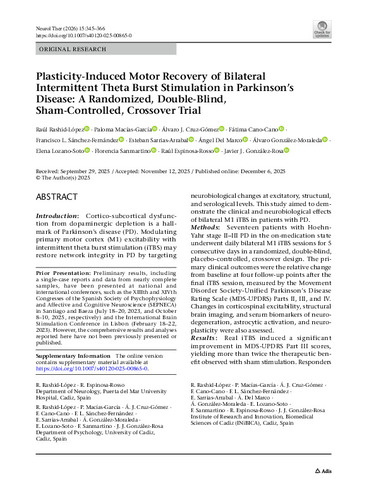
Cortico-subcortical dysfunction from dopaminergic depletion is a hallmark of Parkinson's disease (PD). Modulating primary motor cortex (M1) excitability with intermittent theta burst stimulation (iTBS) may restore network integrity in PD by targeting neurobiological changes at excitatory, structural, and serological levels. This study aimed to demonstrate the clinical and neurobiological effects of bilateral M1 iTBS in patients with PD.
Bilateral M1 iTBS may represent a valuable adjunctive therapeutic option for pharmacological treatment of motor symptoms in patients with PD by promoting structural brain changes and enhancing synaptic plasticity in intermediate disease stages.
Colecciones
- Artículos Científicos [11777]
- Articulos Científicos Biomedicina [577]
- Artículos Científicos INIBICA [1083]
- Articulos Científicos Psicología [433]

Esta obra está bajo una Licencia Creative Commons Attribution-NonCommercial-NoDerivatives 4.0 Internacional