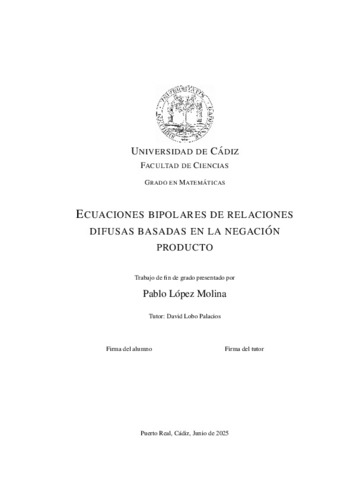
Ecuaciones bipolares de relaciones difusas basadas en la negación producto
Identificadores
Statistics
Export





Metadata
Show full item recordAlternative title
Bipolar fuzzy relation equations based on the product negation
Date
2025-07Advisor
Lobo Palacios, David
Abstract
En el presente trabajo de fin de grado se estudia la resolución de ecuaciones bipolares
de relaciones difusas basadas en la t-norma producto. El estudio comprende
diferentes tipos de ecuaciones, en función del operador de negación
usado, y aborda cuestiones como la resolubilidad de las mismas y la estructura
algebraica del conjunto de soluciones.
En el Capítulo 1, se introduce el tema a tratar en el trabajo, además de la motivación y estructura del mismo. En el Capítulo 2, se exponen algunas nociones previas y resultados que serán
esenciales para el desarrollo de la memoria. En el Capítulo 3, se presenta la noción de ecuación bipolar de relaciones difusas, y se muestra que el estudio de tales ecuaciones es equivalente a la resolución de sistemas de sup-ecuaciones bipolares. En particular, se consideran sup-ecuaciones bipolares basadas en la t-norma producto y se prueban algunas propiedades elementales de las mismas.
El Capítulo 4 se centra en sup-ecuaciones bipolares basadas en la t-norma producto
y su negación adjunta. En este capítulo, se caracteriza la resolubilidad
de estas ecuaciones, así como la existencia y determinación de soluciones maximales
y minimales. Seguidamente, se extienden los resultados obtenidos a
sistemas de sup-ecuaciones bipolares, tratando cuestiones como la resolubilidad
y el conjunto de soluciones maximales y minimales.
En el Capítulo 5, se propone el concepto de negación suelo, que se define como
una modificación de un operador de negación. El eje fundamental de este
capítulo se centra en la resolución de sup-ecuaciones bipolares y sistemas de
sup-ecuaciones bipolares basadas en la t-norma producto y la negación suelo
de una negación involutiva. Además, la existencia y determinación de soluciones
maximales y minimales serán estudiadas.
Destacar que el desarrollo de este capítulo es resultado del trabajo de investigación realizado en el proyecto de fin de grado, y su contenido se ha presentado como comunicación oral en el congreso internacional “16th European Symposium on Computational Intelligence and Mathematics (ESCIM 2025)”, ha sido aceptado en el congreso nacional “XXIII Congreso Español Sobre Tecnologías
Y Lógica Fuzzy (ESTYLF)” y publicado como capítulo de libro.
Por último, en el Capítulo 6 se muestra un ejemplo práctico que pone de manifiesto
la utilidad de los resultados obtenidos en los capítulos previos. La
memoria termina con algunas conclusiones y propuestas de trabajo futuro en
el Capítulo 7. In this work, the resolution of bipolar fuzzy relation equations based on the
product t-norm has been studied. The study comprises different types of equations,
depending on the considered negation operation , and addresses issues
such as the solvability of the equations and the algebraic structure of their
solution set. The document is structured as follows.
Chapter 1 introduces the subject of the work, as well as its motivation and its
structure. Chapter 2 presents some previous notions and results that are essential
for the development of the project. In Chapter 3, the notion of bipolar
fuzzy relation equation is presented and it is shown that the study of such equations
is equivalent to solving systems of bipolar sup-equations. In particular,
bipolar sup-equations based on the product t-norm are considered, and some
elementary properties are proved.
Chapter 4 focuses on bipolar sup-equations based on the product t-norm and
its adjoint negation. In this chapter, the solvability of these equations is characterized,
as well as the existence and determination of maximal and minimal
solutions. Then, the obtained results are extended to systems of bipolar sup-equations
based on the product t-norm and its adjoint negation, dealing with
issues such as solvability and the the study of the set of maximal and minimal
solutions.
In Chapter 5, the concept of floor negation is proposed, which is defined as a
modification of a negation operator. The main focus of this chapter provides
a comprehensive overview of the solvability of bipolar sup-equations and systems
of bipolar sup-equations with the product t-norm and the floor negation
of an involutive negation. Moreover, maximal and minimals solutions of these
equations and systems are studied. It should be noted that the development of
this chapter is the result of the research work carried out in this project. Its
content has been presented as an oral communication at the international conference
”16th European Symposium on Computational Intelligence and Mathematics
(ESCIM 2025)”, accepted at the national conference ”XXIII Congreso
Español Sobre Tecnologías Y Lógica Fuzzy (ESTYLF)” and published as a
book chapter.
Finally, Chapter 6 provides a practical example that demonstrates the usefulness
of the results obtained in the previous chapters. The work concludes with
some conclusions and proposals for future work in Chapter 7.
Collections

This work is under a Creative Commons License Attribution-NonCommercial-NoDerivatives 4.0 Internacional