Influence of the substrate type on CVD grown homoepitaxial diamond layer quality by cross sectional TEM and CL analysis
Identificadores
URI: http://hdl.handle.net/10498/17163
DOI: 10.1016/j.diamond.2011.01.044
ISSN: 0925-9635
Ficheros
Estadísticas
Métricas y Citas
Exportar a





Metadatos
Mostrar el registro completo del ítem
Fecha
2011-01-01Fuente
Diamond and Related Materials 20 (2011) 428-432Resumen
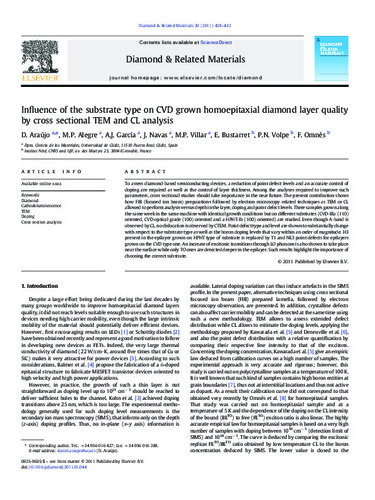
To assess diamond-based semiconducting devices, a reduction of point defect levels and an accurate control of doping are required as well as the control of layer thickness. Among the analyses required to improve such parameters, cross sectional studies should take importance in the near future. The present contribution shows
how FIB (focused ion beam) preparations followed by electron microscopy related techniques as TEM or CL allowed to performanalysis versus depth in the layer, doping and point defect levels. Three samples grown along the sameweek in the same machinewith identical growth conditions but on different substrates (CVD-IIIa (110)
oriented, CVD-optical grade (100) oriented and a HPHT-Ib (100) oriented) are studied. Even though A-band is observed by CL, no dislocation is observed by CTEM. Point defect type and level are shown to substantially change with respect to the substrate type as well as the boron doping levels that vary within an order of magnitude. H3 present in the epilayer grown on HPHT type of substrate is replaced by T1 and NE3 point defects for epilayers grown on the CVD type one. An increase of excitonic transitions through LO phonons is also shown to take place near the surface while only TO ones are detected deeper in the epilayer. Such results highlight the importance of choosing the correct substrate.
Colecciones
- Artículos Científicos [12077]
- Articulos Científicos CC. Mat. [585]
- Artículos Científicos IMEYMAT [581]